Community Story
Anji - Bamboo Sea Wilderness Luxury Guide
"Scenery" is the layered emerald of ten thousand mu of bamboo sea, while "flavor" is the clear, sweet aftertaste of wild bamboo shoots and high-mountain white tea
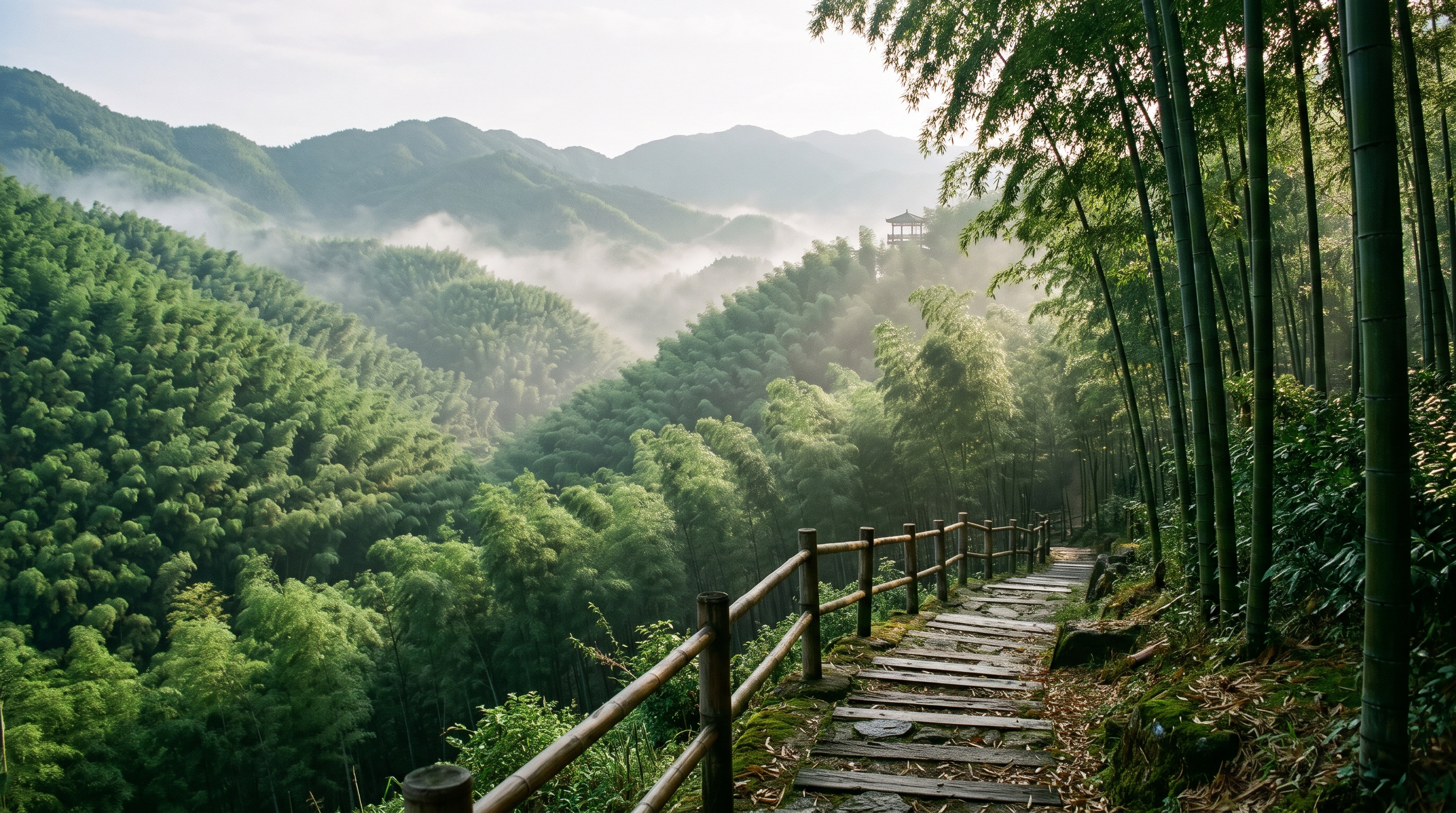
In the weekend map of Baozhehu,"scenery" is the layered emerald of ten thousand mu of bamboo sea, while "flavor" is the clear, sweet aftertaste of wild bamboo shoots and high-mountain white tea. In this "counter-urbanization" oasis just 2 hours away by car, what rises in layered peaks is not only the remaining ridges of the Moganshan range, but also a sensory staircase stacked layer upon layer from Tianmu Mountain springs, wild mountain delicacies, and modern wilderness luxury aesthetics.
As a "dual-habitat walker" accustomed to deciphering geography with my own two feet and anchoring flavors with my tongue, I have always believed:A vacation that does not absorb the mountain and field atmosphere is just lying flat in a different place; only by immersing the tip of the tongue in local produce can one truly complete a deep spiritual conquest of a city.
Today, we do not talk about cubicles, only about the bamboo sea and tea soup. We will take you through 24 hours, using Anji's natural latitude and longitude as clues, to dissect the ultimate wild luxury flavor skeleton of this back garden of Jiangsu, Zhejiang, and Shanghai.
1. [Route Axis]: 24-hour "Bamboo Sea × Wild Luxury Tea Space" dual-habitat route
This is a route designed specifically for urbanites who crave "oxygen absorption" and "stomach cleansing" on weekends. In the morning, walk through the cinematic bamboo sea; in the afternoon, immerse yourself in a minimalist wild luxury tea space, completing a mountain and field baptism with both taste and vision at the same time.
Time period | Spatial coordinates (location) | Scenery/experience highlights | Taste coordinates (recommended categories) | Per-person budget |
|---|---|---|---|---|
08:30 - 10:30 | Dipu Subdistrict · Main City Old Street | The morning mist just disperses; watch mountain folk carry freshly dug bamboo shoots into town for the market | Anji Lao Gan Ma dry-tossed noodles + fried egg | ¥18 - ¥25 |
11:30 - 14:00 | Tianhuangping Town · Dazhuhai/Canglong Baipu | The same bamboo sea as in "Crouching Tiger, Hidden Dragon", with ten thousand stalks of green bamboo rippling like ocean waves in the wind | Braised pork with wild dried bamboo shoots from Tianmu Mountain + free-range chicken soup cooked over firewood | ¥80 - ¥120 |
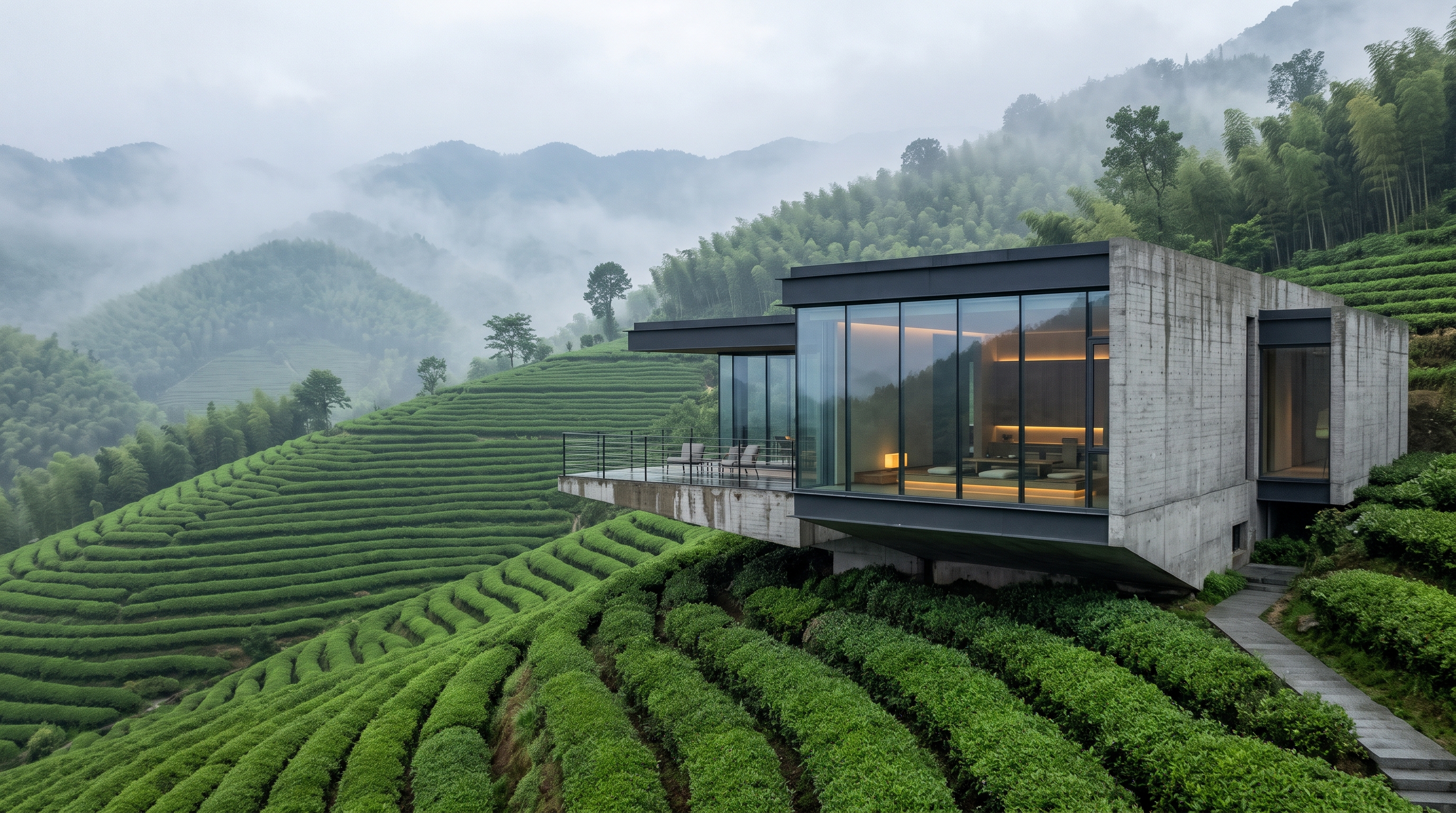
14:30 - 17:30 | Xilong Township · Huangdu Village wild luxury tea space | A minimalist geometric building suspended above ten thousand mu of white tea gardens, visually stunning | Authentic Anji white tea (cold brew/hot brew) + tea snacks | ¥68 - ¥158 |
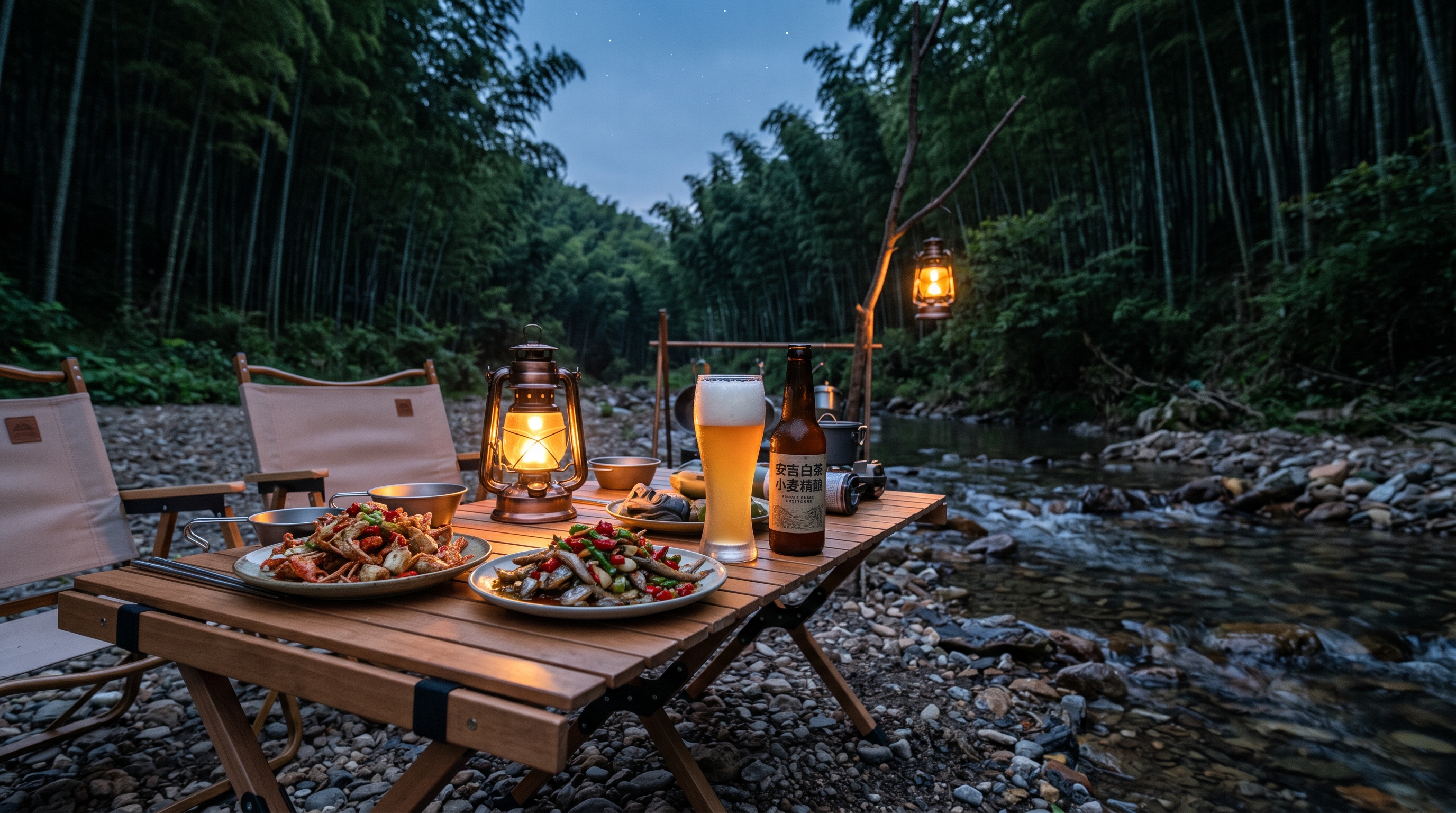
18:30 - 21:00 | Baofu Town · Valley stream food stall | As dusk closes in, listen to the sound of the water on the wooden boardwalk by the stream and watch the scattered stars | Stir-fried stream fish + salted wild mountain frog | ¥90 - ¥130 |
21:30 - 23:30 | Lingfeng Subdistrict · Bamboo Forest Secret Realm Bar | Neon-lit cyber countryside, a craft beer bar on a cliffside hidden among bamboo groves | White tea-flavored craft beer / specialty cocktails | ¥60 - ¥90 |
Travel route
Driving / Approximately 205 minutes by car / 138.7 km
- 1Dibu Subdistrict Cultural and Sports Center
60 meters northeast of the intersection of Wushan Temple Road and Longdun Road
- 2Xilong Huangsheng Yunwu Tea Garden
No. 6, Muzhuta, Huangdu Village, Xilong Township
- 3Anji Shenxi Canyon Rafting (temporarily closed)
Entrance of Shenxi Hongjia Village, Baofu Town
- 4Canglong Baipu
Daxi Village, Tianhuangping Town
- 5Yunshang Grassland Bamboo Expo Garden
Within Lingfeng Tourism Resort (east side)
2. [Core Dish Card]: A Hardcore Deconstruction of the Three Main Characters of Anji's Mountains and Wilds
Dish One: Anji White Tea (High-Mountain Core Production Area)
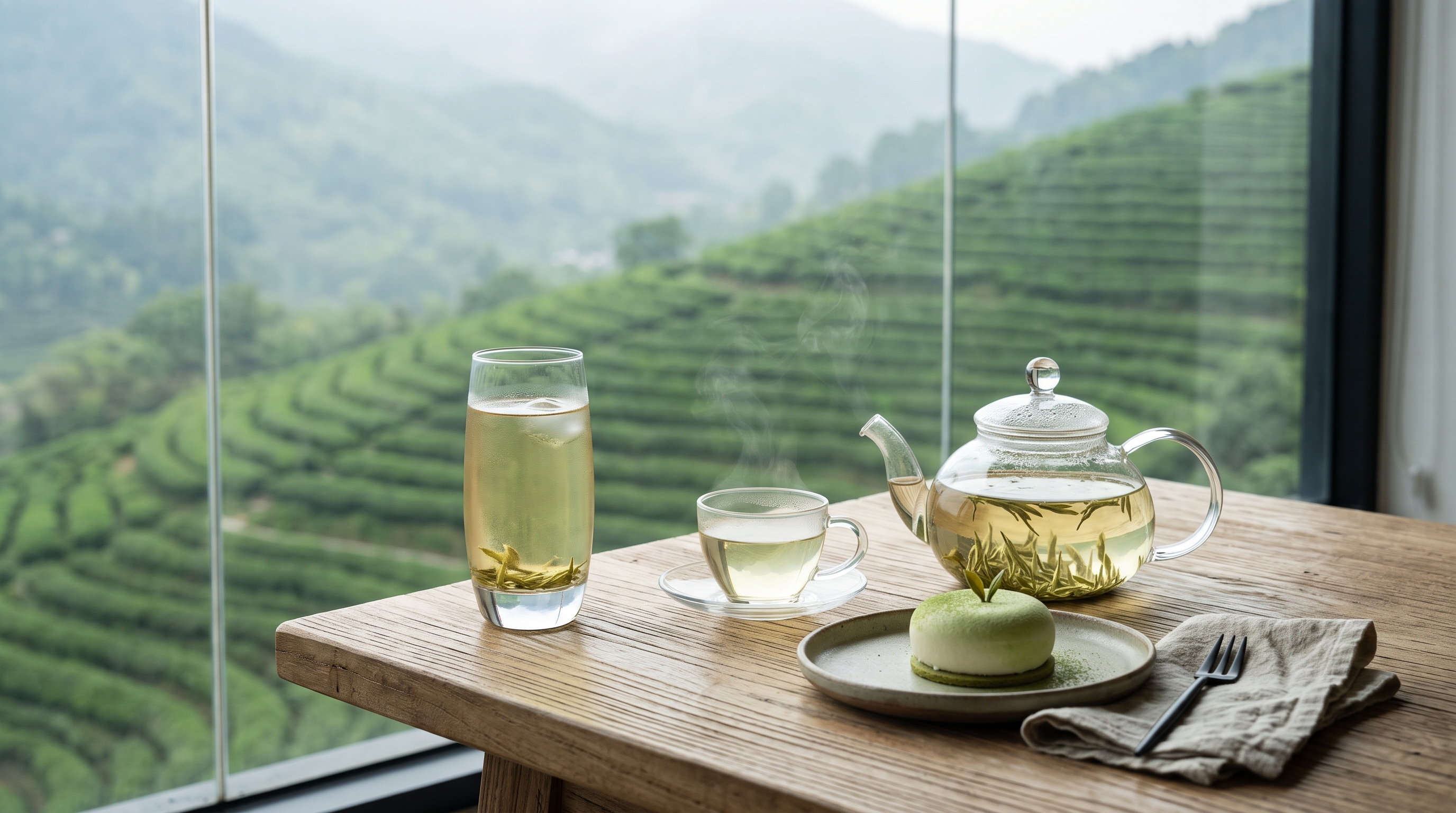
Origin Story: Although Anji white tea is named "white tea", it is actually a geographical indication product of the green tea category; the place where its mother plant was discovered is usually said to be in the Tianhuangping area, while Huangdu Village in Xilong Township is one of today's important white tea production areas. This is a rare temperature-sensitive mutant tea plant: at specific low temperatures in spring, the leaves undergo phased albinism, causing theiramino acid content to be 3-4 times higher than that of ordinary green tea, while the content of tea polyphenols, which bring a bitter and astringent taste, is extremely low. Tea farmers of that time regarded it as "a gift from the gods"; today it has become the visual and taste totem of China's high-end wild luxury tea spaces.
Insider ordering code words:
"Phoenix shape"/"single bud": The appearance is like phoenix feathers, the leaves are lustrous white, and the leaf veins are emerald green; this is the top-grade appearance.
"Pre-Qingming first flush": Temperatures are low before Qingming, the degree of albinism is the highest, and amino acids are the most abundant.
Wild luxury space tea-drinking guide: In the floating tea space, facing ten thousand mu of tea mountains,absolutely do not rush to swallow the first infusionAuthentic Anji white tea should be brewed with 85℃ mountain spring water. As the tea slides down your throat, first feel its almost chicken-soup-like “fresh and brisk sensation” (this is the power of high amino acids), followed by an ethereal Huilan orchid aroma exhaled from your nasal cavity. When ordering in a tea space, the high-scoring answer is the “one hot, one cold” combination: a cup of hot-brewed tea to savor its orchid aroma, and a cup of cold brew to feel the ultimate sweetness bursting on your tongue.
Dish Two: Braised Pork with Tianmu Wild Dried Bamboo Shoots (or Freshly Simmered Spring Bamboo Shoots)
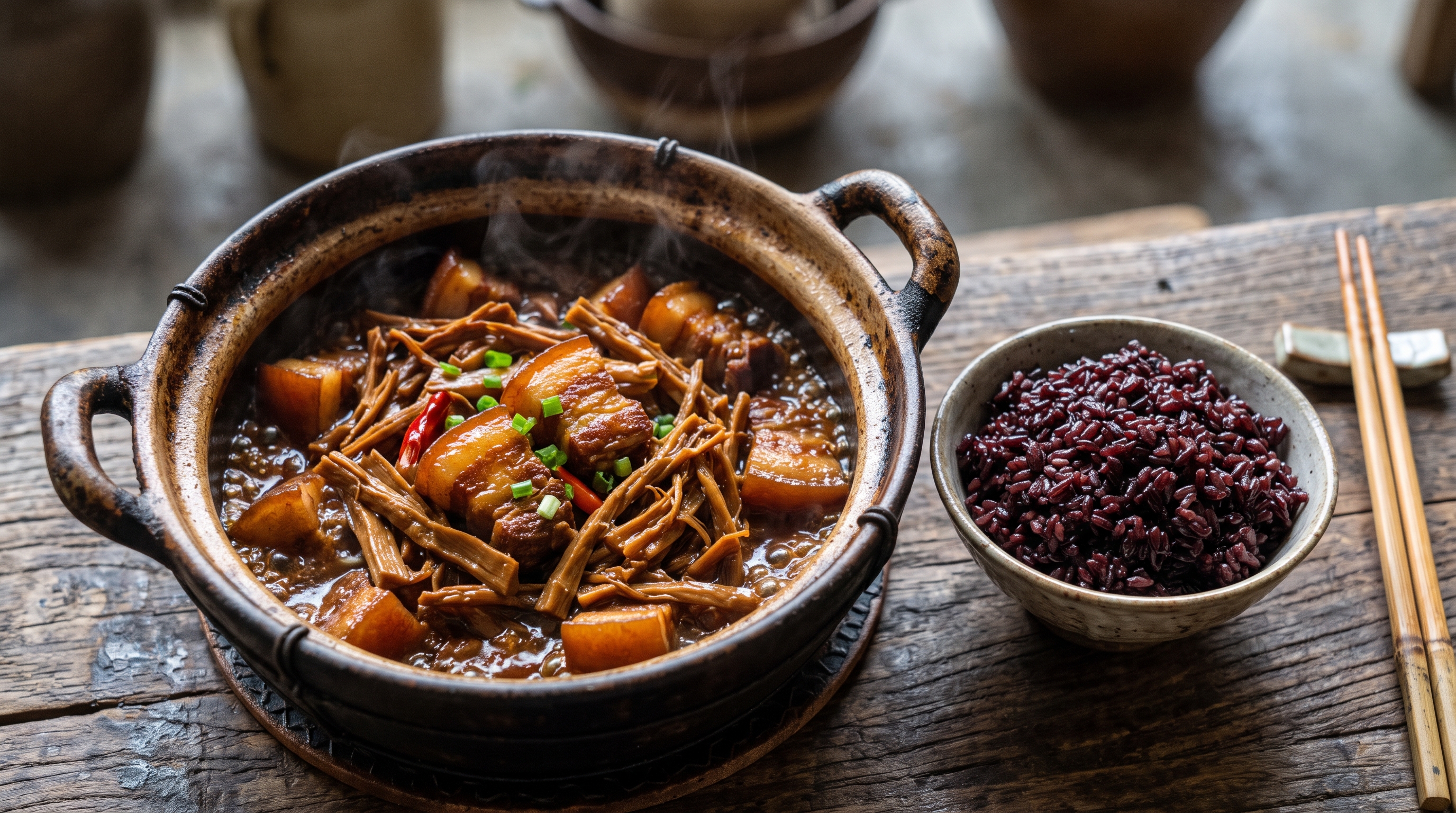
Origin Story: Anji is a famous hometown of bamboo in China, with continuous bamboo forests. In the early years, there was no cold-chain technology. To preserve the fleeting freshness of spring, mountain villagers boiled freshly dug moso bamboo shoots or stone bamboo shoots in a large pot over firewood, then slowly baked them over charcoal into dried bamboo shoots. This method not only locked in the fibrous texture of the shoots, but also, during dehydration, concentrated the complex umami of the mountains and wilds, making it the highest-standard signature dish with which mountain people entertained Huizhou and Shanghai merchants in those days.
Guide to Judging Life or Death by Looking at the Pot:
Look at the “color”: truly wild dried bamboo shoots are by no means pale white (that means they have been fumigated with sulfur), but present a healthy amber or deep yellowish-brown.
Look at the “meat fat”: the essence of this dish lies in “borrowing oil.” In good braised pork with dried bamboo shoots, the pork belly must be stewed until the fat is completely rendered out, while the dried bamboo shoots, like a sponge, absorb the lard completely.
Insider's Guide to Eating: The clay pot is brought to the table, still sizzling.Do not eat the meat first; pick up a chopstickful of the sauce-red dried bamboo shoots. The dried bamboo shoots, saturated with animal fat, linger in the mouth through countless turns, offering both a chewy, springy bite and the fresh sweetness of the deep mountains, directly cutting the greasiness of the pork belly. At this point, the high-scoring answer is to ask the owner for a bowl ofhigh-mountain black rice, pour the sauce over it—this is the most hardcore carbohydrate highlight of the Jiangsu and Zhejiang mountain wilds.
Dish Three: Stir-Fried Stream Fish
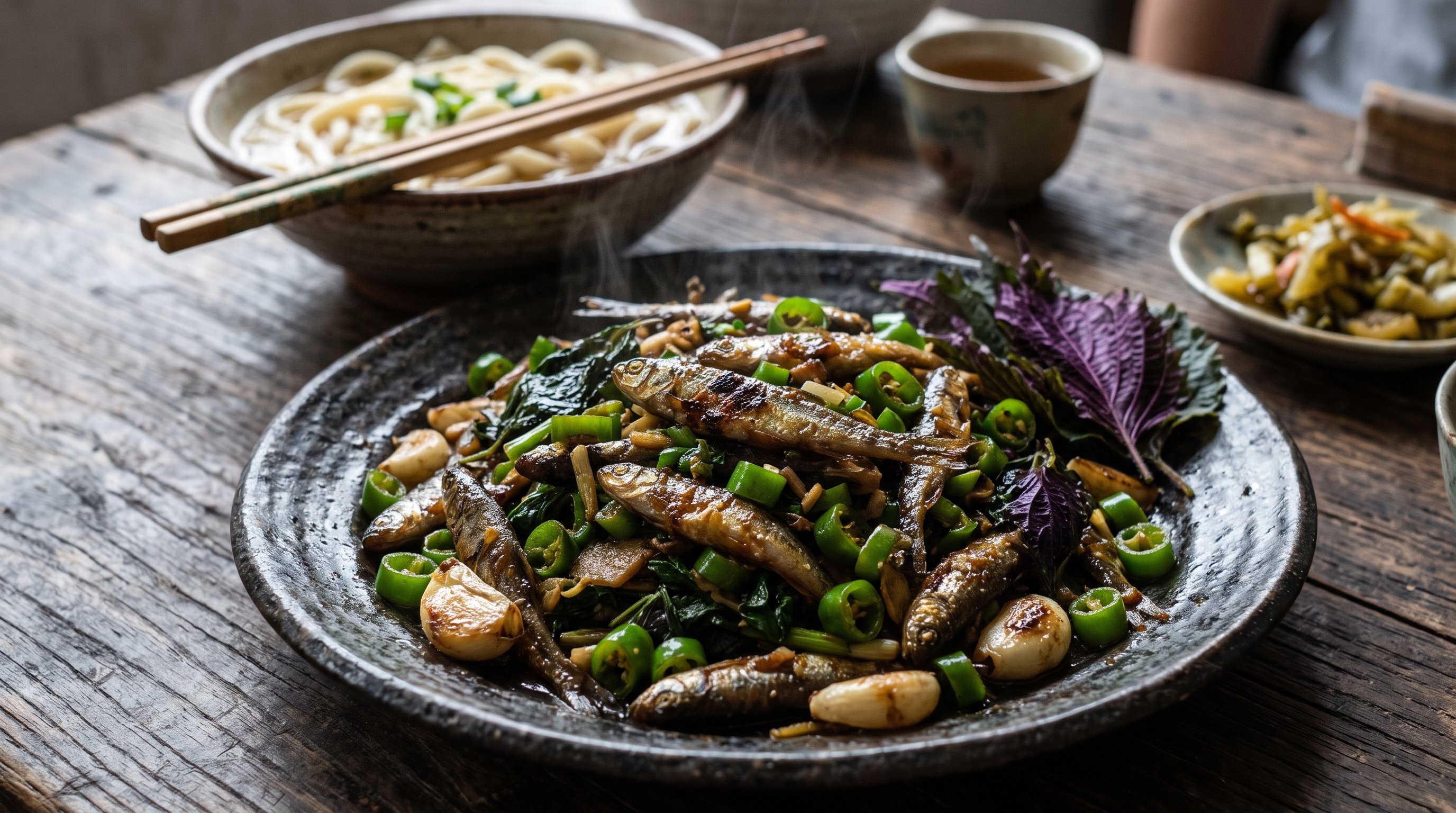
Origin Story: Anji is located at the northern foot of Tianmu Mountain, with streams crisscrossing the area, and the water quality is maintained year-round at the national Grade I surface water standard. In the streams here grows a small fish that never grows large (locals call it stream fish or stone barbel). Because the current is swift, the fish battle the torrent every day, so their flesh is extremely firm and springy. After catching the fish by the stream, the mountain folk need no complicated preparation; they simply stir-fry it over high heat with local green chilies and perilla leaves. It was an absolute hardcore dish that once powered the nightlife of the western Zhejiang river docks.
Hardcore Ordering Guide:
"Stir-fried whole with bones and spines": Stream fish do not need to be deboned; the most authentic method is to cook them whole in the wok.
"Perilla must be added": Perilla is the soul of this dish and perfectly brings out the wildness of the stream fish.
A no-fail eating guide: This dish is absolutely a "god-tier dish for drinking." Pick up a small fish glistening translucent under the sauce and put it in your mouth together with bone and flesh. Because the heat is high and the cooking is fast, the fish bones have been stir-fried until slightly crisp; chew vigorously, and the fresh heat of the green chilies, the unusual fragrance of perilla, and the tender freshness of the fish meat collide instantly on the tongue. The high-scoring way insiders eat it is:After finishing the fish, use the chopped perilla and green pepper left at the bottom of the plate to mix a local “tuomian” (a type of hand-rolled thick noodle), and that fresh spiciness will instantly bring you back to full health.
3. [Coordinate Matrix]: A flavor-seeking map where mountains and wilderness intersect with minimalism
When looking for food in Anji, you need to understand that "the great hermits hide in the city, the lesser hermits hide in the wild." In the main town, what you eat is the old grassroots street atmosphere upheld for decades, while in the valleys, what you eat is the sense of relaxation of being one with nature.
Alleys/Old Street Old Shops (what you eat is the local residents' everyday-life history)
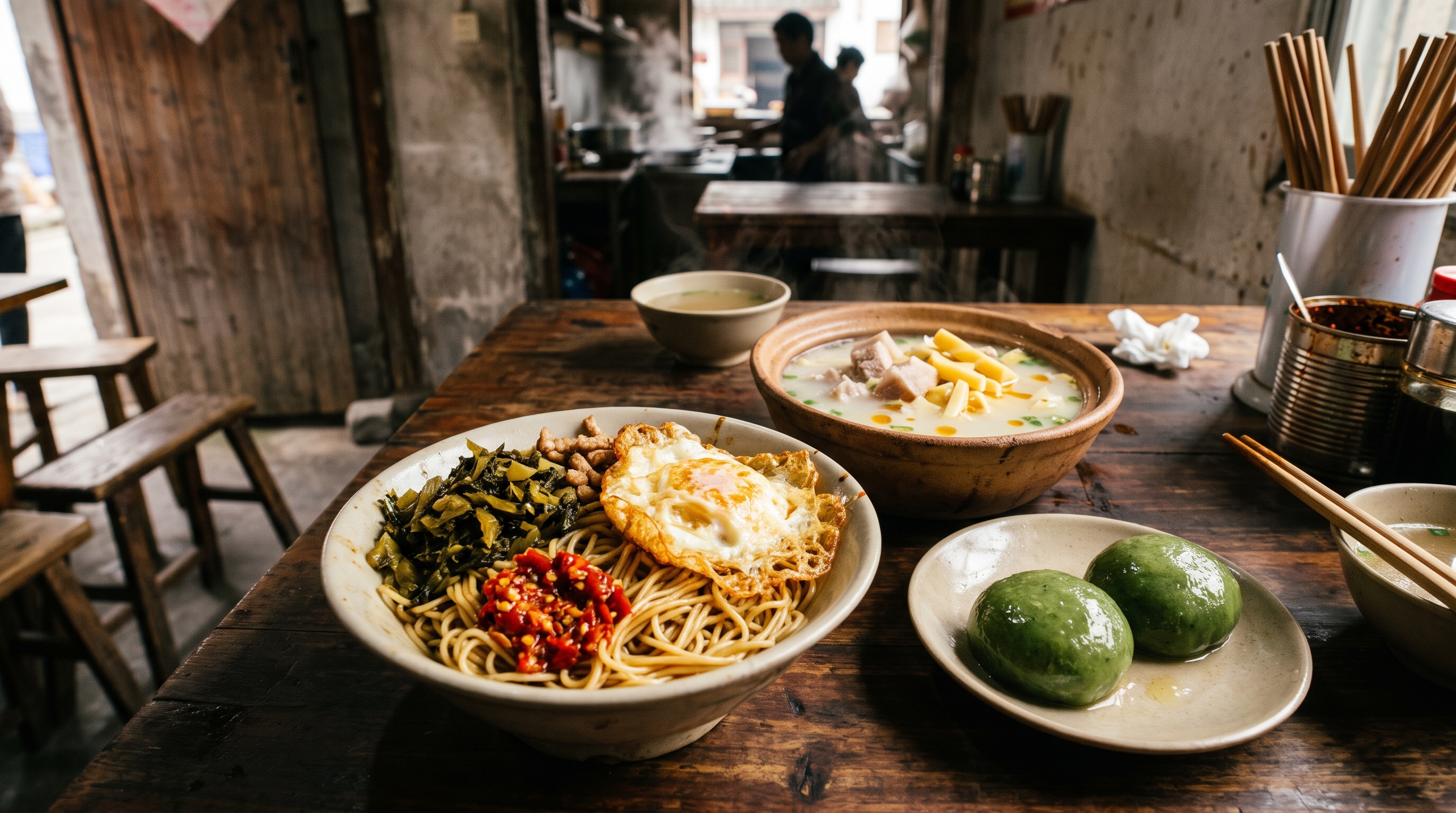
Old noodle shop near the old market in Dipu: This is the morning faith of Anji people. Order a bowl of "dry-tossed noodles"; the noodles are chewy, and the topping is freshly stir-fried pickled mustard greens with shredded pork or pork liver. Be sure to add a spoonful of the shop's homemade local chili sauce (Anji people call it Lao Gan Ma, but it is fresher and spicier than the commercially sold kind). One bowl goes down and feels extremely solid.
Old street market in Baofu Town/Zhangcun Town: This is the ultimate place to find the most authentic "salted pork simmered with bamboo shoots"and"handmade qingtuan." The grannies in the mountains simmer soup in large iron pots over earthen stoves; the salted pork is cured at home, and the bamboo shoots were pulled from the back mountain that very morning. Not a grain of MSG is added, yet it is so fresh it brings tears to your eyes.
Old alleys of Xiaofeng Ancient Town: As the seat of Anji's former county government, this place hides many unnamed snack stalls. For example, "you da zhu" fried with vegetable cakes, and the oily, soft, and glutinous"hui zhi tuan"; these crafts passed down through several generations still maintain a conscientious price of just a few yuan.
Night market/wild luxury food spots (what you eat is a cyber mountain-wild and aesthetic vibe)
Xilong Township's ten-thousand-mu tea sea · minimalist tea space cluster: This is synonymous with "wild luxury." The famousOne Leaf Tea SpaceorWaterfall Cafeis located right here. Huge floor-to-ceiling windows bring the lines of the tea hills indoors; order a cold-brewed white tea here, pair it with white tea mousse, and the photo hit rate is extremely high—it is a visual spiritual totem for escaping the city on weekends.
Tianhuangping Fujiwara Tofu Shop/Jiangnan Tianchi Mountain Road Rest Stop: As the lights come on, this mountain road known as the "Akina of Anji, Zhejiang" gathers the coolest bikers and campers in all of western Zhejiang. The late-night rest stop by the road offers piping-hothigh-mountain small potatoes,charcoal-grilled dried stone bamboo shootsand the steaming hotwhite tea oden.
Baofu Creek Valley food stalls bring: after 9 PM by the creek in Baofu Town, countless camping-style food stalls lit with hurricane lanterns line up along the stream. You can soak your feet in the icy creek water while the table is set withstir-fried creek fish,salt-and-pepper wild mountain crabs (a kind of small stream crab), and in your hand a chilled glass ofWhite Tea Wheat Craft Brew. Amid the roar of the creek and the crisp bamboo breeze, you will find that the anxiety of Shanghai or Hangzhou has long been cured without a trace by the mountain flavors just 2 hours' drive away.
Article comments
Share your thoughts on “Anji - Bamboo Sea Wilderness Luxury Guide”
Loading reviews…
Please wait